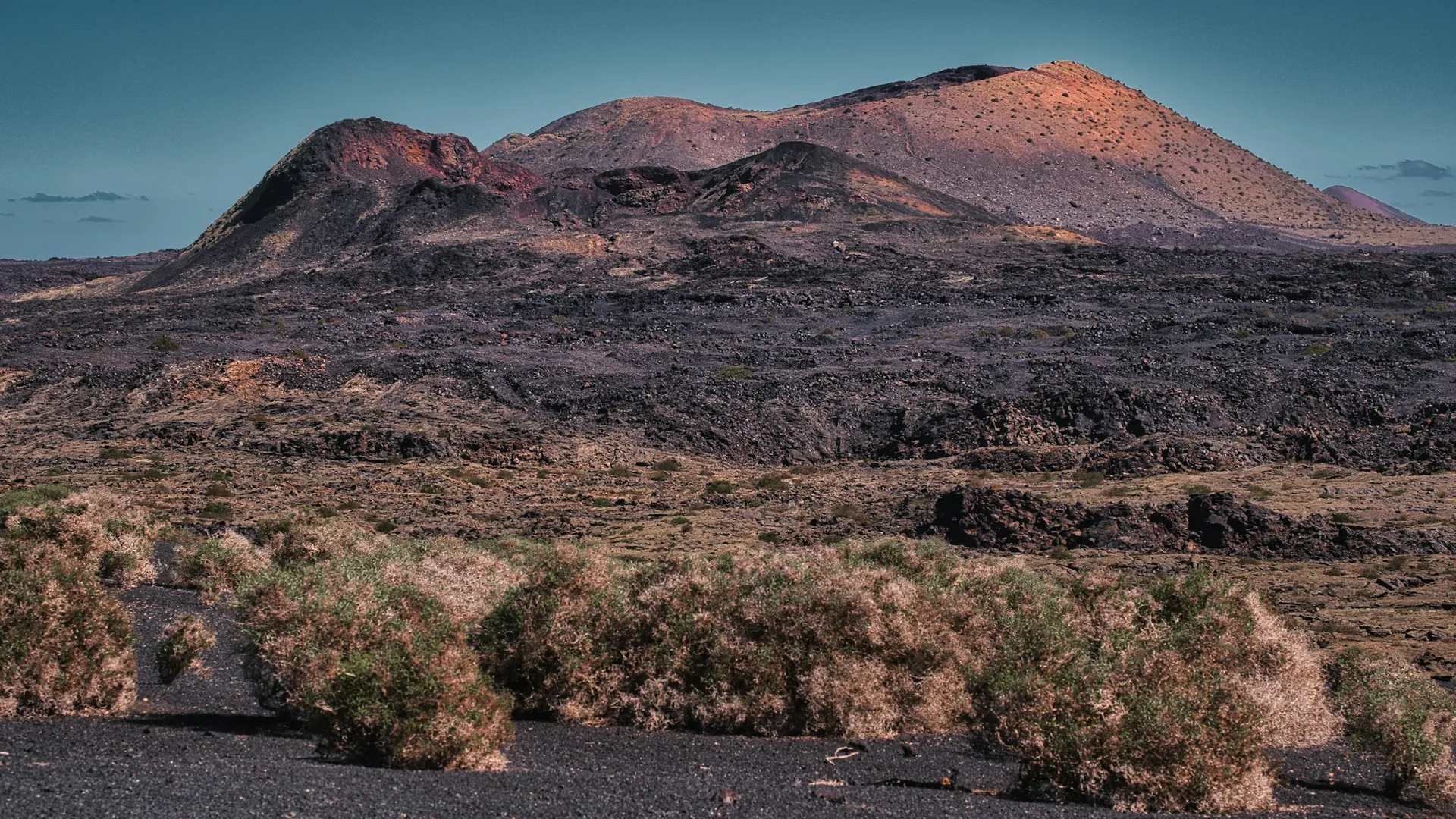
Lanzarote looks different from the other Canary Islands. Instead of green forests you see volcanic cones in red and brown, black lava fields and white villages in between. The reason goes back almost 300 years. From 1730 to 1736, volcanoes erupted here and buried almost a quarter of the island under lava and ash. Today it is exactly this landscape that draws so many visitors.
The island at a glance
| Sight | Location | Why go |
|---|---|---|
| Timanfaya National Park | West | Fire mountains, lava fields, heat from the ground |
| La Geria wine region | Centre | Vines in black ash behind stone walls |
| Jameos del Agua | North | Lava cave with a saltwater lake, designed by Manrique |
| Mirador del Río | North | View of the small neighbouring island of La Graciosa |
| Playas de Papagayo | South | Pale coves with calm water |
| Famara | Northwest | Long beach below steep cliffs, surfing |
Timanfaya: the fire mountains
Timanfaya National Park is the island’s best-known sight. In the Montañas del Fuego, the ground just a few metres below the surface is still several hundred degrees hot today. In demonstrations, water is poured into a pipe and shoots back out as steam seconds later, sending up a white cloud. At the restaurant by the visitor centre, food is grilled over the heat rising from the ground.
You explore the inside of the park on a bus tour along set routes. You may not walk there on your own, which protects the fragile landscape. Come early in the day, as it gets busy at the entrance around midday.
La Geria: wine from the ash
Between Timanfaya and the south coast lies one of the most unusual wine landscapes in the world. Each vine stands in its own hollow in the black volcanic ash, sheltered by a semicircular wall of lava stones. The ash holds the night’s dew and supplies the plants with water, even though it hardly ever rains.
Along the road through La Geria, many wineries invite you to tastings. The best known is Malvasía, a fresh white wine. If you want to taste, it is best to have someone else drive. It is worth it.
César Manrique and the white villages
That Lanzarote has hardly any high-rise buildings is mainly thanks to one man. From the 1960s the artist César Manrique campaigned for the island to keep its character. To this day most houses are low and white, with green or blue shutters. Driving across the island today, you see hardly any billboards by the roads, because Manrique fought against those too, and in many roundabouts his large, colourful metal wind sculptures still turn. Since 1993 the whole island has been a UNESCO biosphere reserve.
Manrique designed several places you should see. At Jameos del Agua, steps lead down into a lava cave with a small lake, home to tiny white crabs. At the Mirador del Río in the north you look down from a cliff onto La Graciosa. His former home in Tahíche is built into five lava bubbles and is now a museum.
The most beautiful beaches
The Playas de Papagayo in the south are considered the island’s most beautiful swimming coves: pale sand, calm turquoise water and rocks all around. The coves lie in a nature reserve and are reached by a gravel track, for which there is a small charge per car.
Puerto del Carmen is livelier, with a long sandy beach along the promenade. In Costa Teguise families find shallow bays, and surfers practise their first waves here. Famara in the northwest is quite different. The beach is kilometres long and wild, with steep cliffs rising behind it. It is ideal for surfing, but often too dangerous for swimming because of the currents.
Caves in the lava rock
Besides Jameos del Agua, the Cueva de los Verdes is worth a visit. The cave is part of a lava tube several kilometres long that was formed by a much older eruption. On a guided tour you walk through part of it, with a surprise at the end that we will not give away here.
When is the best time to go?
Lanzarote is a destination for the whole year. In winter the air is around 21 °C during the day, in summer 27 to 29 °C. It rarely rains. The sea is on the fresh side, at 18 °C in February and around 23 °C in September. There is almost always a wind, which makes the heat pleasant. Around Easter and in the autumn school holidays hotels are in demand, while May and June are quieter.
Good to know
The flight from Frankfurt takes about four hours. The clocks go back one hour. Ferries from Playa Blanca reach Fuerteventura in half an hour, which makes a lovely day trip. And if you want to try the island’s speciality in a restaurant, order papas arrugadas: small potatoes in a salt crust with green and red mojo sauce.
flug-123.de editorial team, updated 10 November 2026. We review our guides regularly. Rules can change. If in doubt, the details in your booking apply.


